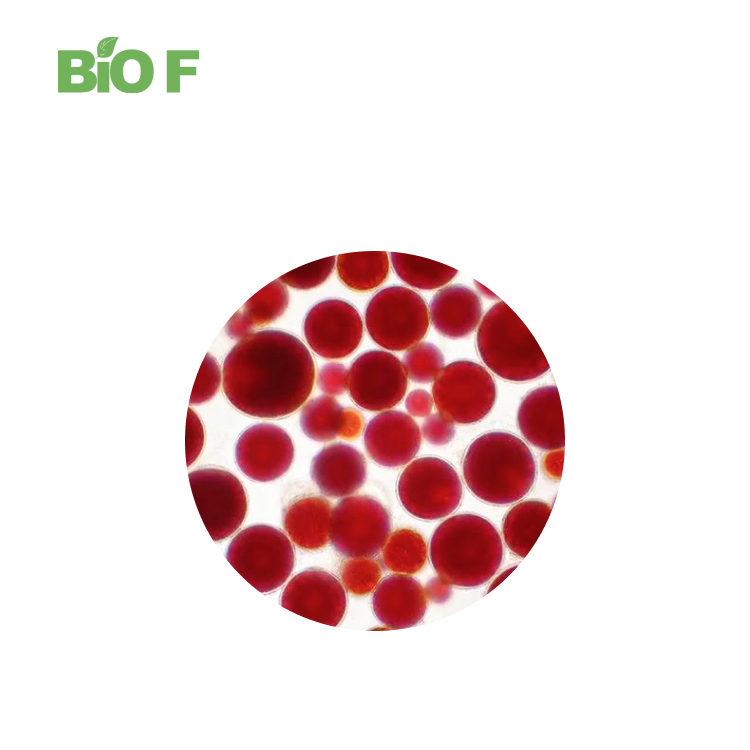
Haematococcus pluvialis is a freshwater unicellular green alga. This alga can accumulate a large amount of astaxanthin, thus showing a red color, and it gets the name “red ball alga”. After the research and development of Spirulina and Chlorella, Haematococcus pluvialis is another economically valuable microalga rich in nutritional and medicinal value. Its main active ingredients include astaxanthin, polysaccharides, proteins, and lipids. In 2010, it was approved as a new resource food in China. Haematococcus pluvialis is recognized as the best natural source of astaxanthin in nature, and its astaxanthin content accounts for about 2.7% – 3.8% of the dry weight of the cells.
Astaxanthin is a ketonic secondary carotenoid. Its molecule is composed of two β – ionone rings connected by a polyene chain, with the molecular formula of C₄₀H₅₂O₄ and a relative molecular mass of 596.84. The astaxanthin synthesized and accumulated in Haematococcus pluvialis accounts for about 2.7% – 3.8% of the dry cell weight, making it an ideal biological source for natural astaxanthin production.
Efficacy of Astaxanthin
1.Antioxidation
Astaxanthin
2.Anti – inflammation
Astaxanthin also exerts anti – inflammatory effects by inhibiting cyclooxygenase and nitric oxide in lipopolysaccharide – stimulated BV2 microglial cells. In vivo studies have also shown that astaxanthin can reduce inflammation in tissues and organs.
3.Anti – apoptosis
Astaxanthin regulates mitogen – activated protein kinase p38, enhances the phosphorylation of Bcl – 2 – associated death protein, down – regulates the activities of cytochrome c, caspase – 3, and caspase – 9, and can also activate the PI3K/AKT signaling pathway, thus improving mitochondrial – related apoptosis.
4.Anti – aging effect
Astaxanthin is a carotenoid with strong antioxidant and anti – inflammatory properties.
Post time: Feb-08-2025


