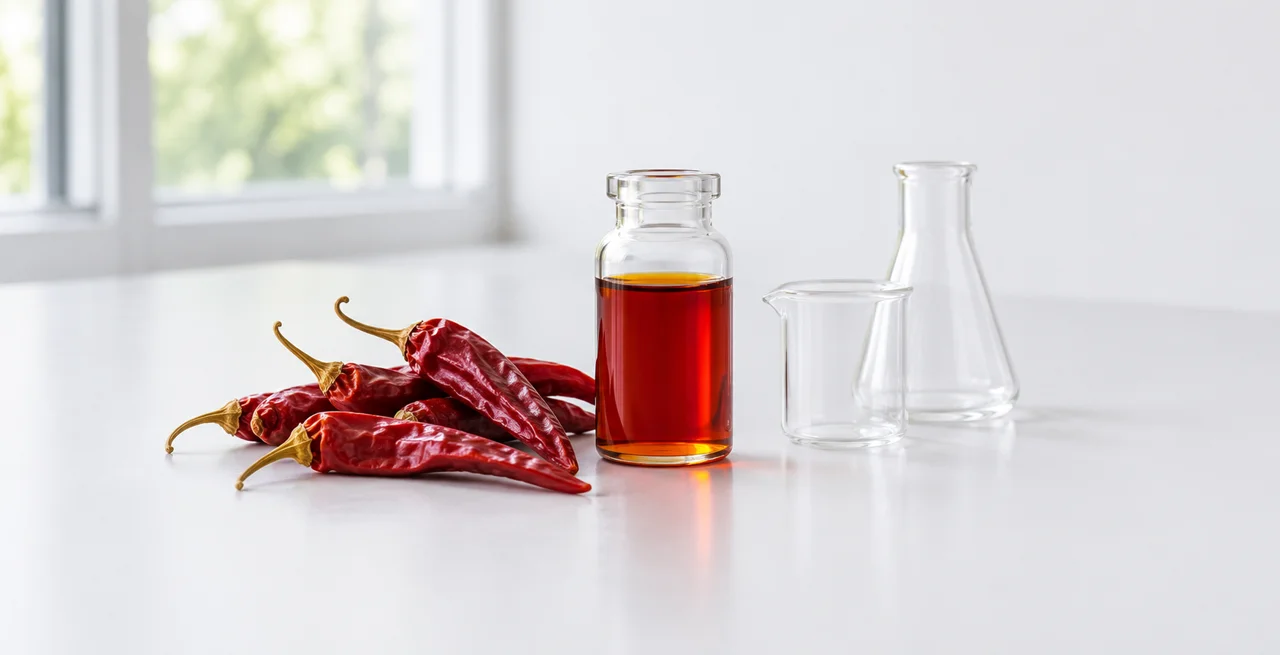
If you are sourcing capsicum oleoresin for a sauce, seasoning or other food system, verify two things before comparing quotes: what the 10% measures, and how the supplied grade behaves in your formula. The grade name alone answers neither question. Two offers can carry the same percentage and still deliver different heat, color or dispersion at the same addition rate.
Ask what the 10% refers to
BIOF lists a 10% water-soluble capsicum oleoresin grade. Before specifying that grade, request the applicable specification and ask whether the percentage refers to capsaicin, a defined sum of capsaicinoids, or another measure. Ask for the units, whether the figure is nominal or a release limit, and whether the test result is reported on the material as supplied.
Capsaicin and total capsaicinoids are different reporting terms. If a report uses a total, ask which compounds are included. If the quote uses Scoville Heat Units, ask how that figure was obtained and which method and reporting convention were used. ASTA Method 21.3 is a published HPLC method for pungency in capsicums and their oleoresins; its existence does not establish which method a particular supplier used.
| On the quote or COA | What to confirm |
|---|---|
| 10% | Named analyte, units, basis, release range and measured lot result |
| Water-soluble | Carrier or dispersion system, mixing instructions and the supplier’s test conditions |
| Red or amber liquid | Appearance of the supplied lot and color contribution in your food system |
| Food application | Composition and the documentation needed for your application and destination market |
Do not use color as a shortcut for heat. The Food Chemicals Codex paprika oleoresin monograph distinguishes the compounds responsible for much of paprika oleoresin’s color from capsaicin. That distinction is useful when discussing purchasing targets; it does not make paprika oleoresin interchangeable with a pungency grade.
Test dispersion in the system you actually make
Some commercial oleoresin preparations use emulsification to improve dispersibility. Kalsec’s delivery-system descriptions provide examples of that distinction. Ask the supplier whether its term “water-soluble” describes dissolution or dispersion, and what the material should look like under the specified test. A uniform but cloudy dispersion can be acceptable in one product and unsuitable in another.
- Set a reference. Record the lot and use the same addition basis across samples. Keep an uncolored or unseasoned control of your base where practical.
- Screen in water, then in your actual base. Use the supplier’s handling guidance. Record water temperature, mixing order, time and agitation. Repeat in the real matrix, including its relevant oil, salt, acid or other components.
- Observe after processing and holding. Record surface oil, rings, sediment, streaks, and color uniformity. Check again after the relevant processing and holding conditions. A fresh mix does not establish shelf stability.
- Assess heat separately. Evaluate pungency through your controlled finished-food sensory procedure at a suitable dilution. Do not taste concentrated oleoresin directly.
What to send with your sample request
Specify the food application, process, desired heat and color, target market, and trial quantity. Request the grade-specific TDS, matching sample COA, composition or carrier declaration and applicable handling information. If color and heat are both acceptance criteria, put both on the brief. Ask the supplier to confirm whether a sample and subsequent order will be supplied against the same agreed specification.
Comparing grades for a trial? Contact BIOF and ask for the 10% water-soluble grade, the assay basis and the carrier declaration. If the test report refers to another grade, request the report for the sample being offered before making your comparison.
Post time: Nov-03-2026


