Recently, in the production chains of multiple industries such as food processing, pharmaceutical formulations, and daily chemical care, Polysorbate 20, a non-ionic surfactant with multiple functions of emulsification, solubilization, and stabilization, has continued to be a "key additive" in formula development across various fields, thanks to its mildness, compatibility, and high efficiency. As an important member of the Polysorbate series (Tween series), Polysorbate 20 not only breaks the limitations of traditional surfactants—such as "single function and limited applicability"—but also, with its characteristics of "low irritation and broad compatibility", plays an irreplaceable role in diverse scenarios ranging from food additives to pharmaceutical excipients, and from daily chemical raw materials to industrial auxiliaries. It has become a "bridge-type ingredient" connecting basic chemical industry and end products.
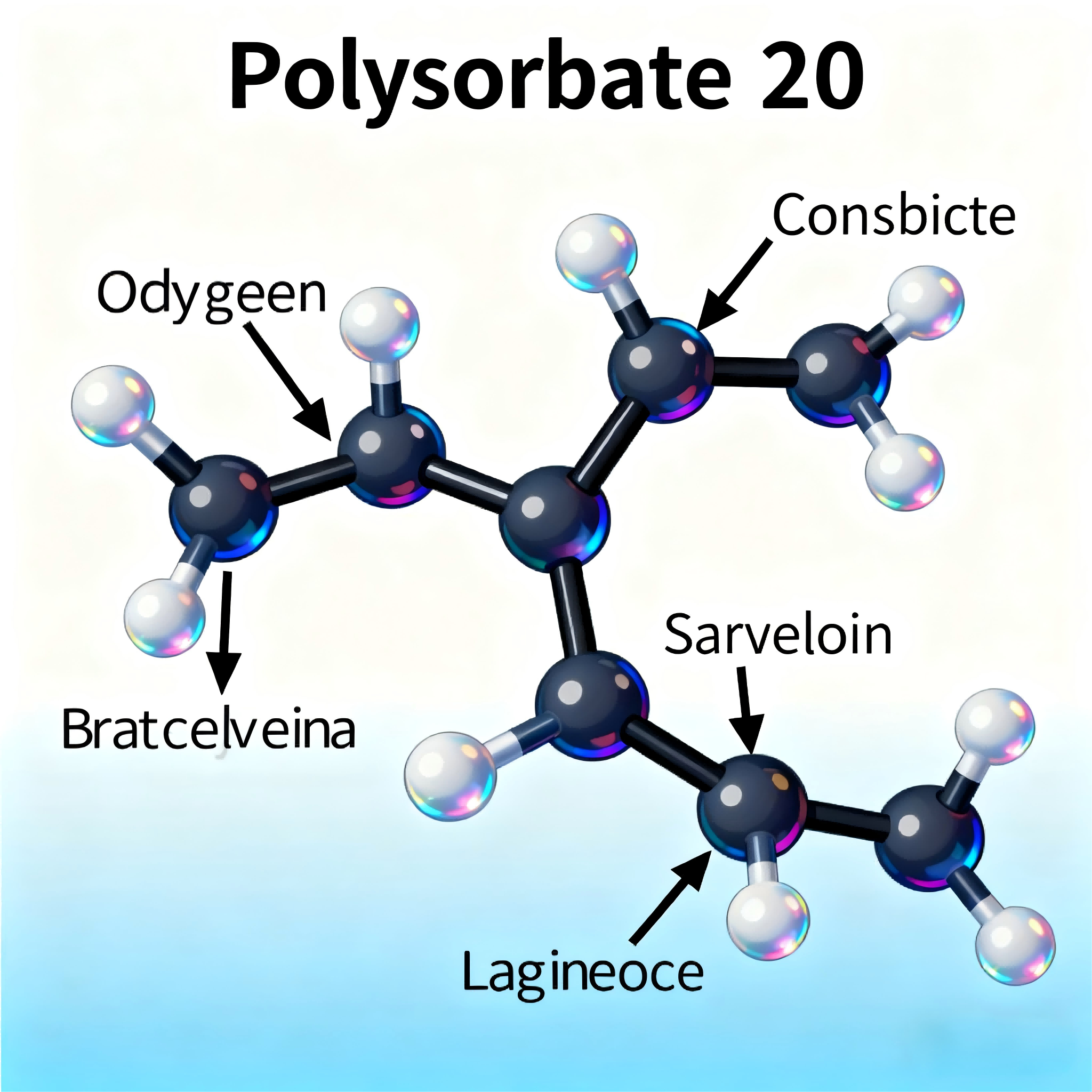
In terms of the product's essence, Polysorbate 20 is a synthetic non-ionic surfactant. Its core chemical structure consists of three parts: "sorbitan", "polyoxyethylene chain", and "laurate group". Sorbitan serves as the basic framework, providing the hydrophilic foundation of the molecule; the polyoxyethylene chain (usually containing 20 ethylene oxide units) further enhances water solubility while improving the molecule's stability; the laurate group endows the molecule with lipophilicity, enabling it to effectively combine with oil-based substances. This "hydrophilic-lipophilic" amphiphilic structure is the core principle behind Polysorbate 20's emulsification and solubilization functions. By reducing the interfacial tension between oil and water, it allows immiscible oil and water phases to form a stable dispersion system, or enables poorly soluble substances to dissolve uniformly in liquids.
In terms of physical properties, Polysorbate 20 typically appears as a pale yellow to amber transparent liquid with no obvious odor. It is easily soluble in polar solvents such as water, ethanol, and glycerol, and also has a certain degree of solubility in vegetable oils and mineral oils. Its pH value usually ranges from 5.5 to 7.5, close to neutral, with extremely low irritation to the skin and mucous membranes. Moreover, it has good compatibility with most organic substances, inorganic substances, and other surfactants, and is less prone to precipitation or stratification. After long-term industrial application and technical verification, relying on its core advantages of "efficient emulsification, stable solubilization, mildness, and safety", Polysorbate 20 has demonstrated outstanding efficacy in four major fields—food processing, pharmaceutical formulations, daily chemical care, and industrial cleaning—becoming a "multi-functional tool" in formulations across various industries.
In the food industry, Polysorbate 20 is mainly used as an emulsifier, stabilizer, and dispersant to address the core issues of "oil-water separation" and "uneven composition" in food systems. For example, in baked goods (such as cakes and bread), adding Polysorbate 20 can fully integrate oil with water, flour, and other raw materials to form a fine and uniform batter. This not only improves the softness and taste of the final product but also delays starch retrogradation and extends the shelf life. In dairy products (such as non-dairy creamer and modified milk), it promotes the uniform dispersion of milk fat globules to prevent stratification while enhancing the product's smoothness. In beverages (such as milk-containing drinks and flavored syrups), Polysorbate 20 helps dissolve poorly soluble ingredients like flavors and pigments, ensuring uniform color and flavor of the product without precipitation. Additionally, as a food additive, Polysorbate 20 has passed safety evaluations in most countries and regions worldwide (e.g., China's GB 2760 National Food Safety Standard for the Use of Food Additives), and poses no health risks to humans when used in compliance with regulations.
In the pharmaceutical industry, Polysorbate 20 is an important pharmaceutical excipient. Its core role is to improve the solubility of drugs and the stability of formulations, thereby enhancing medication efficacy. For lipid-soluble drugs (such as certain vitamins and antibiotics), their poor water solubility leads to low absorption and bioavailability in oral formulations. However, adding Polysorbate 20 can, through solubilization, enable drugs to form stable aqueous solutions or emulsions, increasing the dissolution rate and absorption efficiency of drugs in the gastrointestinal tract. In injections (such as vaccines and protein-based drugs), Polysorbate 20 acts as a stabilizer to prevent drug components (such as proteins and peptides) from aggregating or precipitating during storage or transportation, ensuring drug activity. In topical medications (such as ointments and eye drops), its mildness and compatibility reduce irritation to the skin and mucous membranes, while promoting the uniform distribution and penetration of drug components at the site of action. Currently, pharmaceutical-grade Polysorbate 20 must meet strict pharmaceutical standards, with extremely high purity requirements, and undergo special tests such as sterility and pyrogen-free testing to ensure medication safety.
In daily chemical products, Polysorbate 20 is widely used in skincare products, shampoos, body washes, and other products due to its mildness and multi-functionality. In skincare products (such as lotions, creams, and serums), it acts as an emulsifier to combine oil-phase ingredients (such as vegetable oils and active oils) with water-phase ingredients (such as hyaluronic acid and glycerol) into a stable emulsion system, preventing product stratification. At the same time, it improves the fineness of the texture and application feel, reducing greasiness. In facial cleansers, Polysorbate 20 assists surfactants in exerting cleansing effects while reducing the irritation of other ingredients, making it suitable for people with sensitive or dry skin. In hair care products, it helps hair care essential oils, silicone oils, and other ingredients adhere uniformly to the surface of hair strands, forming a protective film to reduce frizz and enhance hair smoothness. Compared with traditional surfactants (such as soap bases and some anionic surfactants), Polysorbate 20 has lower irritation and a pH value closer to the skin's physiological environment, making it one of the core choices for "mild-type" daily chemical product formulations.
In the field of industrial and household cleaning, Polysorbate 20 can be used as a detergent aid and emulsifier to enhance the stain-removing effect and environmental performance of cleaning agents. In industrial cleaning (such as mechanical part cleaning and metal surface degreasing), it can emulsify oil stains, allowing oily dirt to detach from the cleaned surface and disperse stably in the cleaning solution, preventing dirt from reattaching. Meanwhile, its low-foam characteristic is compatible with cleaning processes such as high-pressure spraying. In household cleaning agents (such as dishwashing detergents and fruit/vegetable cleaners), Polysorbate 20 improves the emulsifying ability of the cleaner against oil stains. It is also readily biodegradable, meeting environmental requirements and reducing pollution to the water environment. Additionally, its mildness allows it to be used in high-end cleaning scenarios (such as precision instrument and electronic component cleaning), avoiding corrosion or damage to the cleaned objects.
Polysorbate 20 are now available for purchase at Xi’an Biof -Technology Co., Ltd. For more information , visit https://www.biofingredients.com.
XI'AN BIOF BIO-TECHNOLOGY CO.,LTD
Email: Tom@xabiof.com
Tel/WhatsApp: +86-15091533695
Website: https://www.biofingredients.com
Post time: Oct-11-2025


