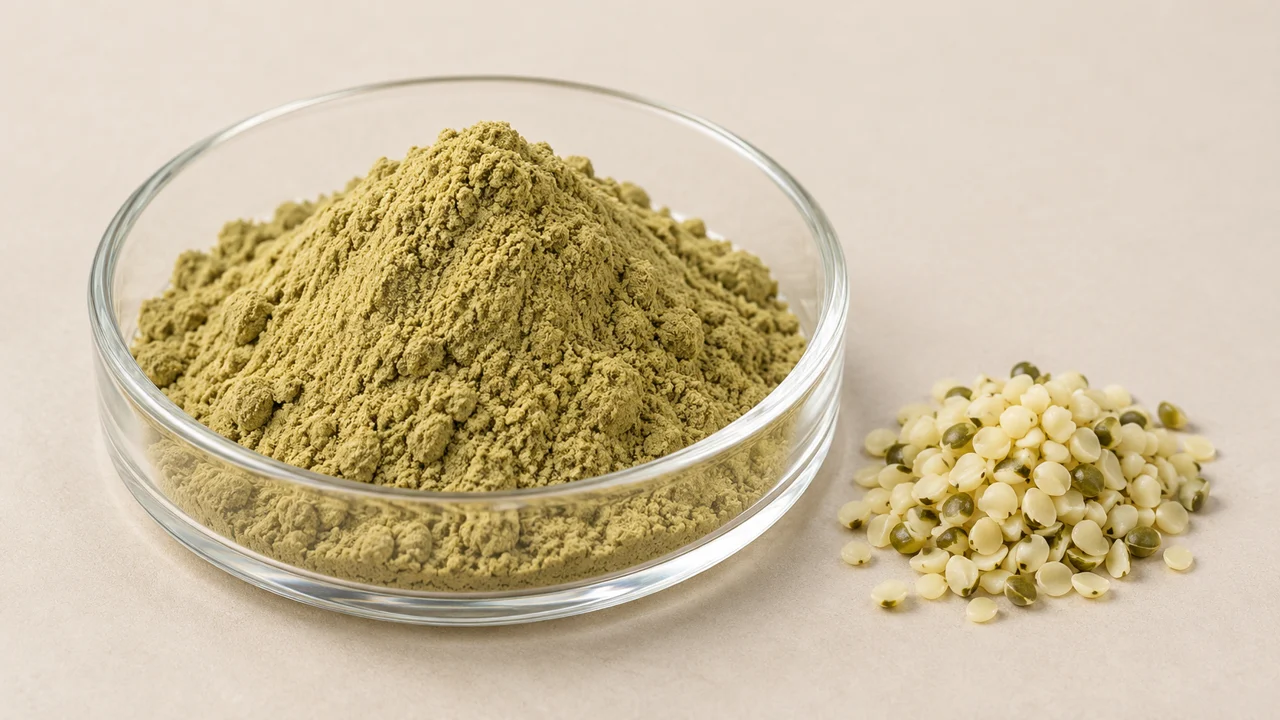
A 60% protein claim is a useful starting point for sourcing hemp protein powder. It does not describe the whole ingredient, and it does not tell you how the powder will behave in a drink, bar or baked product. Before comparing prices, confirm the reporting basis and test method, then check the other properties your application needs.
Is the protein result dry basis or as supplied?
The same material can produce different percentages depending on how moisture is accounted for. A dry-basis result excludes moisture from the denominator. An as-supplied result describes the material including its moisture.
For illustration only, a powder containing 60% protein on a dry basis and 8% moisture by mass would contain approximately 55.2% protein as supplied, assuming moisture is the only adjustment. The calculation is 60% × (1 − 0.08). This is not a result for BIOF’s product. Ask for the basis stated on the actual specification and COA before making a formula calculation.
How was protein measured?
Ask for the analytical method and any nitrogen-to-protein conversion factor used. Total-nitrogen methods estimate protein through a conversion; the reported percentage needs to be read in that context. The FDA’s nutrition-labeling guidance discusses nitrogen-based calculation and the use of a specified conversion factor. It also distinguishes protein quantity from calculations used for protein daily-value declarations. That guidance does not establish the method used on a particular supplier’s lot.
When comparing two offers, request equivalent reporting bases. “60% minimum” is a specification limit; a value in the result column describes the tested lot. Neither is a promise about the protein per serving in your finished food.
Look beyond the headline percentage
| Check | Why it belongs in your brief |
|---|---|
| Moisture and reporting basis | Needed to interpret and compare the protein result |
| Particle size | Helps plan screening for texture and dispersibility |
| Fat and fiber | Relevant to formulation balance, texture and sensory evaluation |
| Appearance, flavor and odor | Check in the actual base rather than only in the dry powder |
| Microbiological and contaminant specifications | Match the application, sourcing requirements and destination market |
| Origin, composition and allergen documentation | Needed for your purchasing and finished-product review |
Do not assume “protein powder” means a clear, completely soluble ingredient. Test the offered grade. For a beverage, compare mixing behavior, visible particles and settling at defined times. For a bar or bakery system, evaluate the target recipe rather than extrapolating from a water test. Use the same dose, process and observation conditions when comparing samples.
Make the sample request specific
BIOF lists Hulled Hemp Seed Protein 60%. Ask for its current specification and the COA for the sample lot, including protein method and reporting basis. If organic status is part of your brief, request applicable certification and scope rather than relying on the product name alone.
Contact BIOF with your application, process, target protein contribution, trial quantity and destination market. A matching sample and document set gives you a stronger basis for selection than the headline percentage by itself.
Post time: Nov-05-2026


