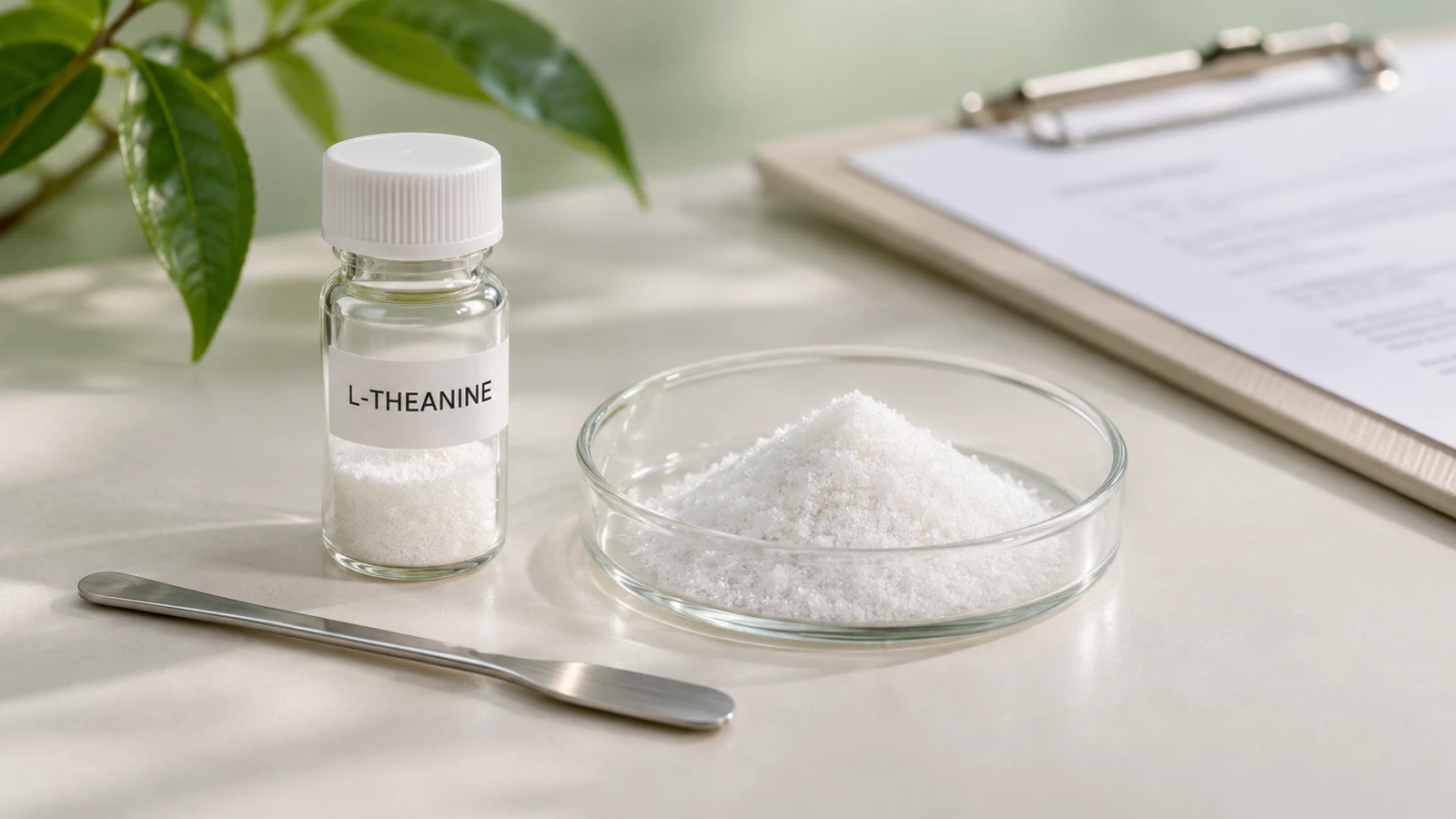
An L-theanine certificate of analysis helps a buyer connect an ingredient specification to a particular batch. For a small food or supplement company, the useful questions are practical: Does the lot match the sample? What does the assay result mean? Which tests are missing for the intended application?
This guide uses the ESUREY L-theanine COA for batch ES-261015LT, published in the BIOF document library. It explains the reported results and the questions to ask before placing a bulk order. These figures describe this reference batch, rather than every lot available from a supplier.
Download the reference L-theanine COA.
Start with identity and batch dates
The document identifies the product as L-Theanine, CAS 3081-61-6, and names the specification as Company Standard. It records manufacture and analysis on October 15, 2026, with an expiry date of October 14, 2028.
Match ES-261015LT to the container label and the sample paperwork. Before an order, request the COA for the lot actually being offered. An earlier reference certificate can help a quality team evaluate the document format, but it does not release a different batch.
The stated quantity is 500 kg. That is the quantity recorded on this certificate; it is not confirmation of current stock or a minimum order quantity.
Separate specification limits from reported results
Read the specification and result columns together. A specification is the acceptance criterion used in the document; a result is what the certificate reports for this batch.
| Test | Specification on this COA | Reported result |
|---|---|---|
| Appearance | White or almost white crystalline powder | Complies |
| Assay, HPLC | 98.0–102.0% | 99.5% |
| Specific rotation | +7.7° to +8.5° | +8.1° |
| Loss on drying | ≤1.0% | 0.17% |
| Residue on ignition | ≤0.20% | 0.03% |
| pH | 5.0–6.0 | 5.8 |
| Solution clarity | Clear and colorless | Complies |
| Total plate count | ≤1,000 CFU/g | <1,000 CFU/g |
| Yeast and mold | ≤100 CFU/g | <100 CFU/g |
| E. coli | Negative | Negative |
| Salmonella | Negative | Negative |
For method-dependent measurements such as pH and specific rotation, request the preparation and measurement conditions when comparing offers. Numbers from different procedures are not automatically interchangeable.
What does the 99.5% HPLC assay tell a buyer?
The certificate labels this test Assay (HPLC) and reports 99.5% against its stated 98.0–102.0% specification. Preserve that wording when communicating with your quality team.
The document does not explain the complete HPLC procedure, reference standard, or whether the result is expressed on an as-is or dried basis. It also does not describe a chiral separation. Ask for these details if assay comparability or enantiomeric composition is part of your purchasing specification.
Do not relabel the figure as HPLC area purity or claim it proves every other quality attribute. For technical background, ICH Q2(R2) treats analytical performance as dependent on the procedure and its intended use. That reference is background on analytical methods, not evidence that this food ingredient has been tested under an ICH-validated procedure.
Is 0.17% loss on drying a Karl Fischer water result?
No Karl Fischer result is identified in this COA. The reported 0.17% belongs to Loss on Drying.
USP General Chapter 731 describes loss on drying as a measurement of material driven off under specified conditions. It should not be renamed as a water-specific result without supporting method information.
If your raw-material specification calls for Karl Fischer water determination, request that test by name. Also ask for the drying conditions used for the loss-on-drying figure if you need to compare it with another supplier’s result.
Check contaminants without turning limits into “zero” claims
This batch certificate reports heavy metals, expressed as Pb, <10 ppm; arsenic <1 ppm; cadmium <1 ppm; and mercury <0.1 ppm. Those are the entries on this document, not universal purchasing limits for every food or supplement project.
A result below a stated value should not be rewritten as zero. If your specification needs more detailed elemental testing or lower reporting thresholds, request the analytical method and a report suited to that requirement. Likewise, a “Negative” microbiological entry needs its sampling and test details when those are required by your quality system.
Does a clear solution mean the powder is ready for a beverage?
The COA reports compliance with a clear and colorless solution-clarity specification. It does not state a quantitative solubility in g/L, nor does it establish performance in a finished beverage.
For a beverage trial, record the actual liquid, powder concentration, water temperature, mixing time and any sediment after standing. Repeat the relevant checks in the intended formula rather than relying on a photograph of powder dissolved in unspecified water.
For a capsule project, ask about the particle-size and handling information needed by the manufacturing team. Those details are not provided in this certificate.
Confirm origin, packaging and intended use separately
The COA states 25 kg/drum, with an inner plastic bag and an outer cardboard drum. It specifies cool, dry storage away from strong light and heat, and a two-year shelf life when properly stored. Confirm the pack size and remaining shelf life for the offered lot; a sample pack can differ from the reference batch’s bulk packaging.
This certificate does not establish whether the material is tea-extracted, chemically synthesized or fermentation-derived. It also does not provide organic, vegan, allergen or non-GMO declarations. Request the documents that your product brief actually requires.
A batch COA is also separate from the assessment of an ingredient’s intended food use. For a US project, FDA explains that food-ingredient status depends on the conditions of intended use. This reference COA does not establish GRAS status for the supplied grade or approval of a finished product.
Documents to request before a bulk L-theanine order
Send the supplier a short brief covering the application, destination market, trial quantity and target specification. Request:
- The COA for the offered lot and a matching sample-label reference.
- The technical specification and the HPLC assay method or method reference.
- Manufacturing-origin information and any declarations required for the project.
- Application-specific testing, such as a documented beverage dissolution trial or Karl Fischer water result, when needed.
- Confirmed sample availability, bulk packaging, remaining shelf life and quotation terms.
Review BIOF’s L-theanine product page, browse the COA library, or contact the team about your L-theanine project.
BIOF inquiries are handled by XIAN ESUREY BIO-TECHNOLOGY CO., LTD. Include the product name and the documents you need so the team can check the offered grade and lot.
Post time: Nov-19-2026


